The beginning of the end
World War Z“The beginning of the end” is the expression used for the turning point at which the war against the living dead ceases to look like an endless retreat and becomes a long, organized movement toward recovery. Its clearest occurrence follows the first successful operations of the reformed American forces: the dead are destroyed efficiently, the soldiers’ morale returns, and the continental campaign is understood to have begun even though victory remains years away.
The Expression and Its Immediate Context
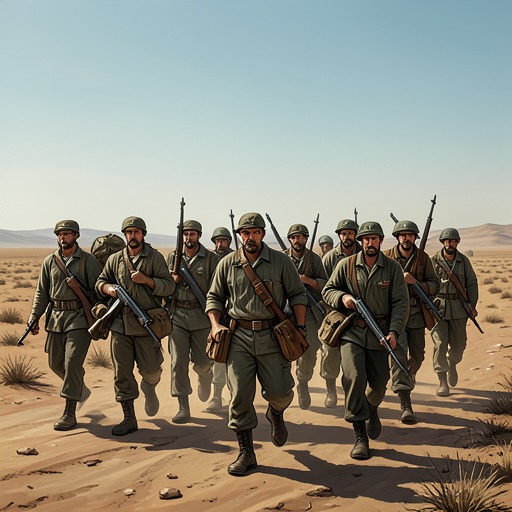
The phrase appears after a battle in which the army’s new doctrine has worked as intended. Infantry stand in two ranks, one firing while the other reloads, maintaining a continuous line of fire; the ammunition is the NATO 5.56 Cherry PIE round, designed to destroy a zombie’s brain without spreading infected matter. After the engagement, dozer-blade Humvees clear a route through the ring of corpses, reserve troops take over burial and cleanup, and the exhausted soldiers march ten miles east to a fortified bivouac. The next day’s delayed awakening supplies the emotional charge behind the expression. Soldiers sleep late, then wake to voices, laughter, and stories rather than the stunned silence that had preceded the attack. The change is not merely tactical. Their confidence, badly damaged by the Battle of Yonkers, has begun to return. The narrator connects that feeling to the president’s promise of reclaiming the future and recalls the declaration that the battle marked “the beginning of the end.” The phrase therefore describes a value shift from paralysis to agency, not the completion of the war.
From Military Failure to Reclamation
The expression gains force through its contrast with the Battle of Yonkers. There, American forces prepared conventional defensive positions on the ground even though rooftops and high buildings offered commanding views of the valley. The soldiers spent time constructing cover and concealment against an enemy that could neither use firearms nor be deterred by ordinary battlefield intimidation. The resulting defeat exposed fear as the weapon that had failed: the living dead could not be shocked or awed, and their immunity to fear turned the army’s own expectations against it. That failure is later reinterpreted as a lesson in military adaptation. General Travis D’Ambrosia develops the resource-to-kill ratio and applies it to weapons, doctrine, and procurement. The rebuilt force favors reliable, inexpensive systems such as the Standard Infantry Rifle, which can be reconfigured for long-range, midrange, or close combat and is described as accurate and resistant to jamming. Its Cherry PIE ammunition eliminates the need for wasteful burning and permits whole infected bodies to be buried after the brain has been destroyed. The phrase marks the public and emotional consequence of these changes: the army has not simply acquired better equipment; it has learned to fight an enemy according to the enemy’s actual nature.
A Beginning That Takes Three Years
The expression does not imply a rapid victory. The campaign later called the road to New York lasts three years. Three Army Groups advance across the Great Plains and Midwest before dividing at the Appalachians, with the northern and southern wings moving toward Maine and Florida while Army Group Center crosses the mountains and the forces eventually link along the coast. The slow pace is deliberate and practical. The army advances in two solid lines stretching from Canada toward Mexico, moving like search teams sweeping a field for wreckage so that no ground is missed. Under the Force Appropriate Response doctrine, a small outbreak does not halt an entire Army Group. A designated unit stops to destroy the zombies, while an equivalent force from the secondary line closes the gap about a mile behind the front. This leapfrogging preserves the advance’s continuity while matching the response to the size of the threat. The result is methodical rather than spectacular, but that method is precisely what makes the beginning credible: progress survives contact with terrain, weather, transport limits, and scattered enemies.
The Phrase’s Darker Echoes
The expression also resonates with other turning points in the book, where an apparent beginning contains the moral structure of a later catastrophe. In Russia, a new commander invokes duty, responsibility, and the oath to protect the motherland before forcing soldiers to vote on which comrades will be executed and then kill them with stones. The punishment is presented as democratic practice, but its lasting effect is collective guilt and the surrender of individual freedom behind the excuse of obedience. A similar logic shapes the Redeker Plan. Because no safe zone can shelter everyone, a fraction of civilians is evacuated while others are confined as living bait, kept alive and supplied so the dead remain fixed around them instead of pursuing the retreating army. The plan may preserve the state, but it does so by converting innocent survivors into an instrument of defense. In Germany, the same crisis produces an opposite moral decision when a West German commander refuses an order to abandon civilians, despite threats that he and his soldiers will be charged with treason. These episodes complicate the optimistic phrase by showing that one historical ending may begin through sacrifice, coercion, or refusal, depending on who controls the language of necessity.
Reclamation, Faith, and Power
In Russia, the beginning of a new national order is associated with the Final Purification. After witnessing infected soldiers prepare to kill themselves, a chaplain shoots one of them and concludes that priests, rather than the soldiers themselves, must release trapped souls from infected bodies. The practice spreads from military chaplains to civilian priests and becomes part of a wider religious revival that helps rebuild the state on the basis of faith. What begins as a response to unbearable suffering therefore becomes a national philosophy, with the potential for spiritual consolation and political misuse. The expression’s final resonance is openly political. The war is said to have driven Russia back to its roots, restored its strength and fearsome reputation, and made Russians feel safe beneath the protective fist of a Caesar. The same historical movement that allows the United States to reclaim its future can thus allow Russia to welcome renewed centralized power. “The beginning of the end” is consequently not a simple promise of happy resolution. It is a threshold phrase: it identifies the instant when defeat is reversed, while leaving open what kind of society will emerge from the victory and what moral costs that society will accept.